The Shape of Understanding: Keeping a Cohesive Viewpoint in a World of Growing Complexity
What centers your world when there are hundreds of competing voices and views? There is a kind of clarity that arrives before language…
A newborn’s knowledge does not begin with creeds or constitutions. It begins with light and pressure, with edges and warmth, with the curve of a mother’s shoulder and the rhythm of breath. Before we inherit the words good and evil, we learn contact and contour. Reality presents itself first as geometry, the felt structure of the world, and only later as morality, law, and philosophy.
A child learns what is good long before rules exist. A steady hand on the stairs feels safe. A sudden shove feels wrong. A warm presence calms. A sharp edge hurts. No explanation is required. Balance, gravity, and care teach the lesson first. Moral language arrives later, naming what the body already knows.
This is not a fanciful idea. Modern physics, at its core, is the study of how matter and time take shape. We now understand that we live inside an invisible lattice of energy and motion that determines what things can do. The shape of electrons inside a crystal governs whether a material conducts electricity or resists it. These patterns sound abstract, but they are what make phones function, batteries store energy, and medical imaging possible. The unseen map of reality increasingly reveals itself through form.
Human beings carry this same order of knowing into culture. We do not live by material facts alone. We build meaning from them. Like branches from a trunk, moral systems emerge as responses to shared reality filtered through need, history, and circumstance. A wolf and a sheep live under the same physics and biology, yet what is good for one is terror for the other. The root is shared. The expressions diverge. People are similar. We are born into a common reality, then shaped by family, tribe, nation, and church. Across cultures, anthropologists and psychologists find recurring moral motifs such as care, fairness, loyalty, authority, and purity. Each society weights them differently, shaping distinct moral silhouettes from the same clay.
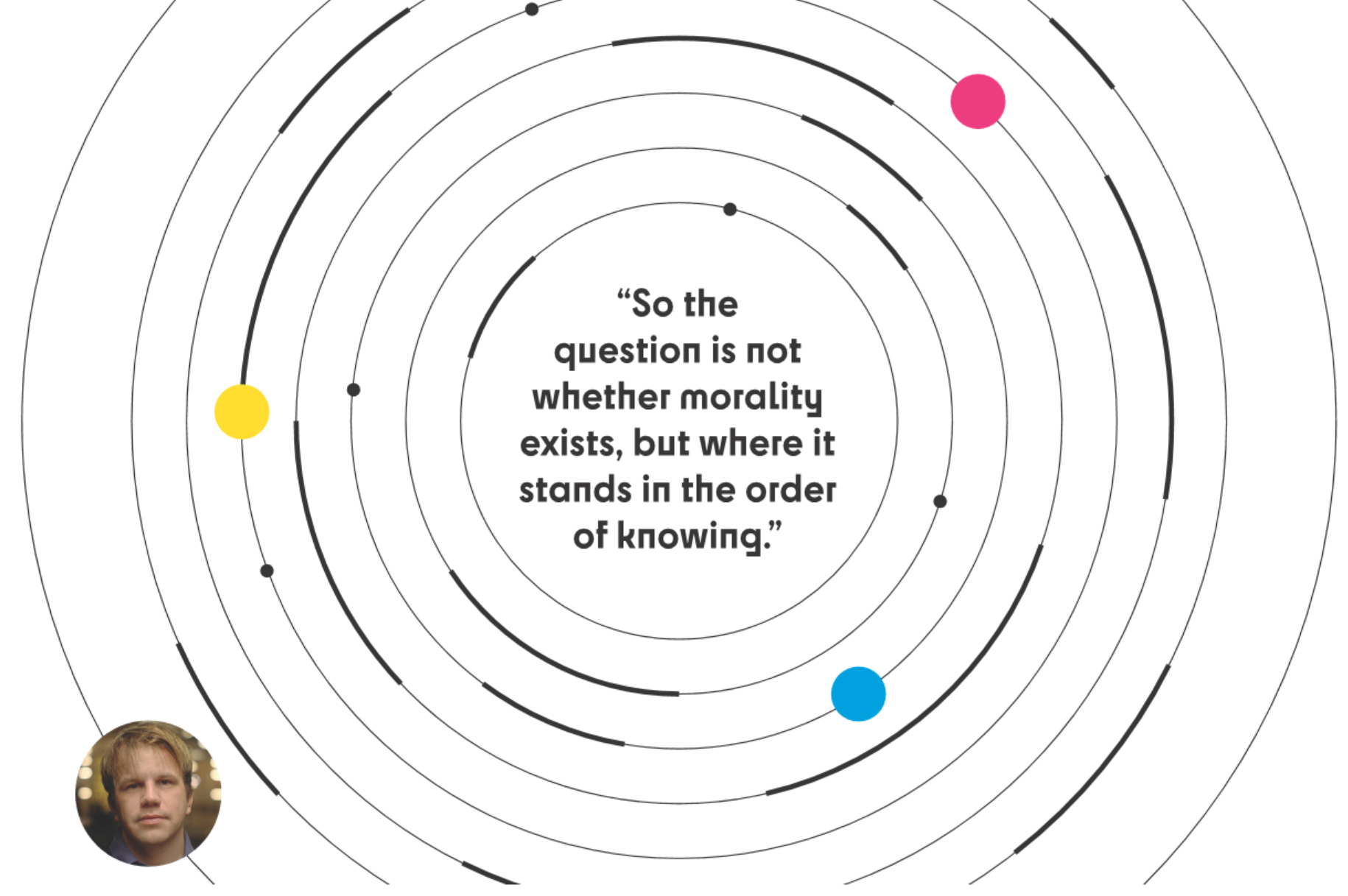
So the question is not whether morality exists, but where it stands in the order of knowing. The claim here is modest and, I think, faithful. Structure comes first. Moral articulation follows. Derivation does not mean arbitrariness. A cathedral’s spire is a derivative of stone and stress, but that hardly makes it meaningless. It means the spire must respect the load paths of gravity. In the same way, a moral code can be local and still answer to something true about the world.
For a Christian, the name given to this underlying order is Logos. “Through him all things were made.” The claim is not that mathematics is God, but that creation is intelligible because it is spoken rather than accidental. Reality has grammar. It has order. It holds together.
In Christian belief, Christ is not an abstraction layered on top of the world. He is the personal disclosure of that order within it. The Logos takes on flesh. What is implicit in creation becomes visible in a life. Christ does not replace the structure of reality. He enters it. He lives within its limits of body, time, hunger, and place. Salvation does not bypass form. It works through it.
This conviction does not seem to grant license to humans to judge every derivative system or to claim knowledge of every soul. It fixes a compass point, we lift Him up, and He does the drawing.
Byron Aho is a writer interested in clarity where life feels noisy, fractured, or overwhelming. His work points toward Christ Jesus as the Way, the Truth, and the Life, and as the source of meaning and renewal, while taking seriously the limits and failures inherent in ordinary human life.
Shaped by time living in Japan, extended travel through Europe, and years of carpentry work alongside academic study, he writes from the ground up. He hopes his work is useful in easing confusion and clarifying the tensions people carry, helping readers think, speak, and live with greater care.
READ NEXT:

Explore the spiritual and cultural contours shaping today’s Christian witness in Project Arctos Issue 81, The Shape of Everything. Reflect on faith in an age of AI, global instability, and shifting moral landscapes—while discovering how theology, vocation, psychology, and Kingdom vision converge to form a resilient, Christ-centered life marked by faith, hope, and love.